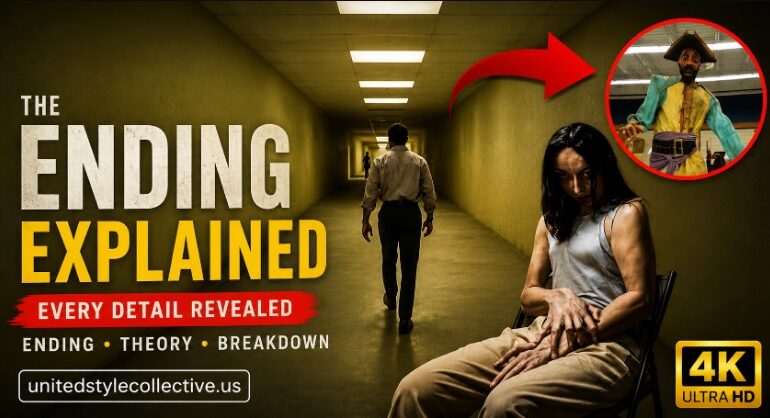
The internet’s most famous urban legend the Backrooms finally made the leap from creepypasta forums to the big screen. If you just finished watching the film and find yourself staring at a blank wall, wondering what the final sequence actually meant, you are not alone. This surreal, liminal nightmare leaves plenty of room for interpretation, but there are concrete narrative threads to pull on.
In this breakdown, we are going to dive deep into the final moments of the film to unpack the true meaning of the ending and what it says about the characters who enter this endless maze.
The Nature of the Labyrinth
To understand the ending, we first have to remember what the Backrooms represent. It is not just a building or a series of rooms; it is a manifestation of existential dread. The architecture itself is sentient, shifting to feed on the fear and memories of those trapped inside.
Also Read: Kristi Noem Height Real Facts About Her Profile
Throughout the movie, we see the protagonist struggling to maintain their grip on reality. The yellow wallpaper, the hum of the fluorescent lights, and the damp carpet smell are all designed to break down the human psyche. By the time we reach the final act, the lines between memory, hallucination, and physical reality have completely blurred.
Breaking Down the Final Sequence
The climax of the film centers on a desperate attempt to reach an “exit” that the protagonist believes will lead back to their original life. However, the Backrooms do not work like a traditional building with a front door.
The Illusion of the Exit
The door at the end of the hall is a trap. In the final scene, as the protagonist reaches for the handle, the environment begins to fold in on itself. This is the Backrooms’ defense mechanism. It gives the victim a glimmer of hope just before it is snatched away.
The Ultimate Fate of the Protagonist
Rather than escaping into a normal room or a familiar hallway, the protagonist falls through a glitch in the floor. This represents a transition into a deeper, more dangerous layer of the Backrooms. The ending confirms that there is no true “outside.” Every exit is simply an entrance into a new, more hostile level of the facility.
Comparing the Movie to the Original Lore
| Aspect | Original Internet Lore | The Movie Adaptation |
| Origin | A random 4chan post in 2019 | A stylized, cinematic expansion |
| The Monsters | Vague, shadow-like entities | Manifestations of past trauma |
| The Ending | No definitive end; eternal loop | A psychological descent into madness |
| Levels | Infinite, numbered levels | A fluid, shifting single nightmare |
Why the Ending Feels So Ambiguous
The director chose to leave the fate of the lead character open to interpretation, which aligns perfectly with the spirit of the original internet phenomenon. If the film provided a definitive “they made it home” ending, it would betray the hopelessness that defines the Backrooms.
The ambiguity serves a specific purpose: it forces the audience to stay in that headspace. You are meant to feel that lingering sense of unease. Even after the credits roll, the film wants you to look at your own hallway and wonder if the lights are humming just a bit too loudly.
Is There a Sequel or a Deeper Meaning?
The conclusion of the film strongly hints at a larger cycle. Some viewers have theorized that the protagonist has actually been in the Backrooms for decades, and the entire movie is just one fragment of a loop they have experienced hundreds of times.
The “movie ending explained” debate often comes down to this: is it a tragedy, or a psychological horror story about letting go? By the time the protagonist stops fighting and accepts the environment, they become part of the decor. They are no longer a visitor; they are a resident of the maze.
Conclusion
The Backrooms film succeeds because it leans into the uncanny valley. The ending is not a puzzle to be solved with one correct answer; it is an experience to be felt. It reminds us that sometimes, the scariest thing isn’t a monster chasing you it is the realization that you are completely, utterly lost, and that the world you once knew is no longer reachable.
Ultimately, the ending represents the death of the ego. To survive the Backrooms, one must lose their sense of self. The protagonist’s final, blank expression as the camera fades to black is the ultimate testament to this. They have stopped being a person and have become just another ghost in the yellow wallpaper.
FAQs
1. Does the main character actually escape the Backrooms?
No, the character does not escape. The final scene confirms that they have simply transitioned into a deeper, more surreal layer of the labyrinth, proving that there is no true exit.
2. What do the entities represent in the movie?
The entities serve as physical manifestations of the protagonist’s internal trauma and grief. They aren’t just monsters; they are the past catching up to them.
3. Is the ending meant to be a loop?
Yes, the thematic elements strongly suggest a cyclical loop. The character seems destined to repeat their descent as part of the facility’s infinite nature.
4. Why is the color yellow so prominent in the final scene?
Yellow is used to evoke feelings of sickness, decay, and artificiality. It contrasts with the organic world, highlighting how trapped and unnatural the environment is.
5. Should I watch the movie more than once to understand it?
A second viewing is highly recommended. Because the movie relies on visual storytelling and subtle cues, you will notice background shifts and audio details that clarify the ending the second time around.
For more updates visit: United Style Collective